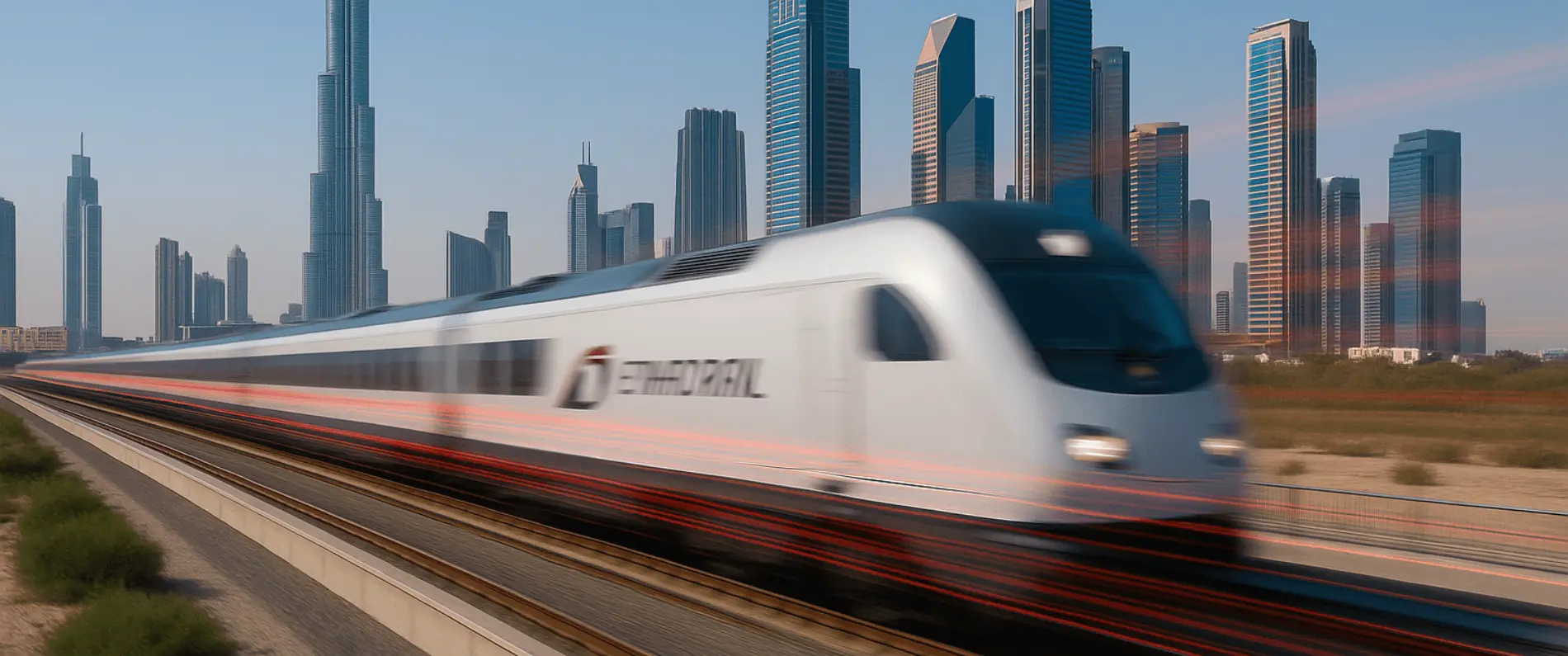
Dubai has officially joined the UAE’s national passenger rail network, marking one of the most significant changes to how people can move between the country’s major cities.
Etihad Rail’s Dubai Station was inaugurated on 28 September, with UAE President His Highness Sheikh Mohamed bin Zayed Al Nahyan travelling aboard the train from Abu Dhabi to Dubai ahead of the official opening. Passenger services connecting Dubai with Abu Dhabi and Fujairah begin on 30 September 2026.
For Dubai, however, the significance goes beyond a new way to travel. The arrival of passenger rail has the potential to change commuting patterns, strengthen connections between employment centres and influence how residents think about where they choose to live.
Dubai to Abu Dhabi from AED 39
The new Dubai station is located at Al Yalayis, next to Jumeirah Golf Estates, with a direct pedestrian connection to Jumeirah Golf Estates Metro Station.
Tickets between Dubai and Abu Dhabi start from AED 39 for Comfort Class, with Premium Class starting from AED 109. The journey takes approximately 64 minutes, while Dubai to Fujairah takes around 70 minutes.
The station is also integrated with Dubai’s wider public transport network. A dedicated pedestrian bridge connects passengers directly with the Dubai Metro, while Nol integration allows travellers to combine Etihad Rail and local public transport journeys using a single QR code across rail, Metro, Tram and bus services.
That integration is important. Rather than operating as an isolated intercity station, Etihad Rail becomes part of Dubai’s existing transport infrastructure.
A Different Kind of Dubai–Abu Dhabi Commute
Perhaps the biggest immediate change is the relationship between Dubai and Abu Dhabi.
Until now, travelling regularly between the two cities has predominantly meant driving. A scheduled rail connection introduces a more predictable alternative and could make regular inter-emirate commuting considerably more practical.
That matters for the property market.
Where someone works does not necessarily have to determine where they live to the same extent if connections between the emirates continue to improve. Someone working in Abu Dhabi, for example, could have greater flexibility to live in Dubai, while Dubai-based businesses gain easier access to employees, clients and commercial activity in the capital.
This effect will take time to become clear, and one rail connection alone will not redraw Dubai’s residential market. But improved transport links have the potential to broaden the areas people consider when choosing a home.
Why the Location Matters
The choice of Jumeirah Golf Estates for Dubai’s first station is also significant.
Al Yalayis Station sits within an established residential corridor and has access to the E311, E44 and D57, as well as a direct connection to the Metro Red Line. A future Gold Line connection is also planned.
For surrounding communities, connectivity is therefore becoming an increasingly important part of the conversation.
Jumeirah Golf Estates, Dubai Production City, Dubai Investments Park and communities further south already benefit from their position between established Dubai and the city’s expanding southern corridor. Etihad Rail adds another piece of major infrastructure to that part of the city.
It would be premature to attribute future property price movements directly to the railway. Property values ultimately depend on supply, demand, the quality of individual homes and communities, and wider market conditions. However, accessibility is an established consideration for buyers and tenants, and the areas surrounding major transport infrastructure are likely to receive greater attention as the network develops.
Dubai Is Becoming More Connected Beyond Dubai
The bigger story is the creation of a genuinely connected national transport network.
Etihad Rail’s passenger network is being introduced in phases. Dubai and Al Dhaid join the network on 30 September, additional Al Dhafra stations are scheduled to follow later this year, and Sharjah’s University City Station is due to open in March 2027.
Longer term, the plans become even more significant.
A separate high-speed rail connection between Dubai and Abu Dhabi is planned to reduce journey times to approximately 30 minutes, with trains operating at speeds of up to 350km/h. Etihad Rail says the high-speed network is expected to support greater labour mobility and economic integration between the two cities.
This starts to change the definition of location.
For Dubai residents, access to another emirate becomes easier. For businesses, the potential employee and client base becomes wider. For buyers, the relationship between home, workplace and commute could become less rigid.
What Does This Mean for Dubai Property?
For Dubai’s residential market, Etihad Rail is unlikely to create an overnight shift. Its importance is more structural.
Dubai’s growth has consistently been supported by investment in infrastructure, from new roads and Metro extensions to airports and expanding public transport networks. Etihad Rail adds national connectivity to that equation.
Over time, buyers may increasingly consider transport connectivity alongside traditional factors such as community, schools, property quality and proximity to work.
That could be particularly relevant for communities around Jumeirah Golf Estates and Dubai’s southern growth corridor, where substantial infrastructure and residential development are already under way.
The first trains departing Dubai on 30 September therefore represent more than another transport option. They mark another stage in Dubai’s evolution from a city connected internally by road and Metro to one increasingly integrated with the rest of the UAE by rail.
And as those connections become faster and more frequent, where people choose to live, work and invest may evolve with them.